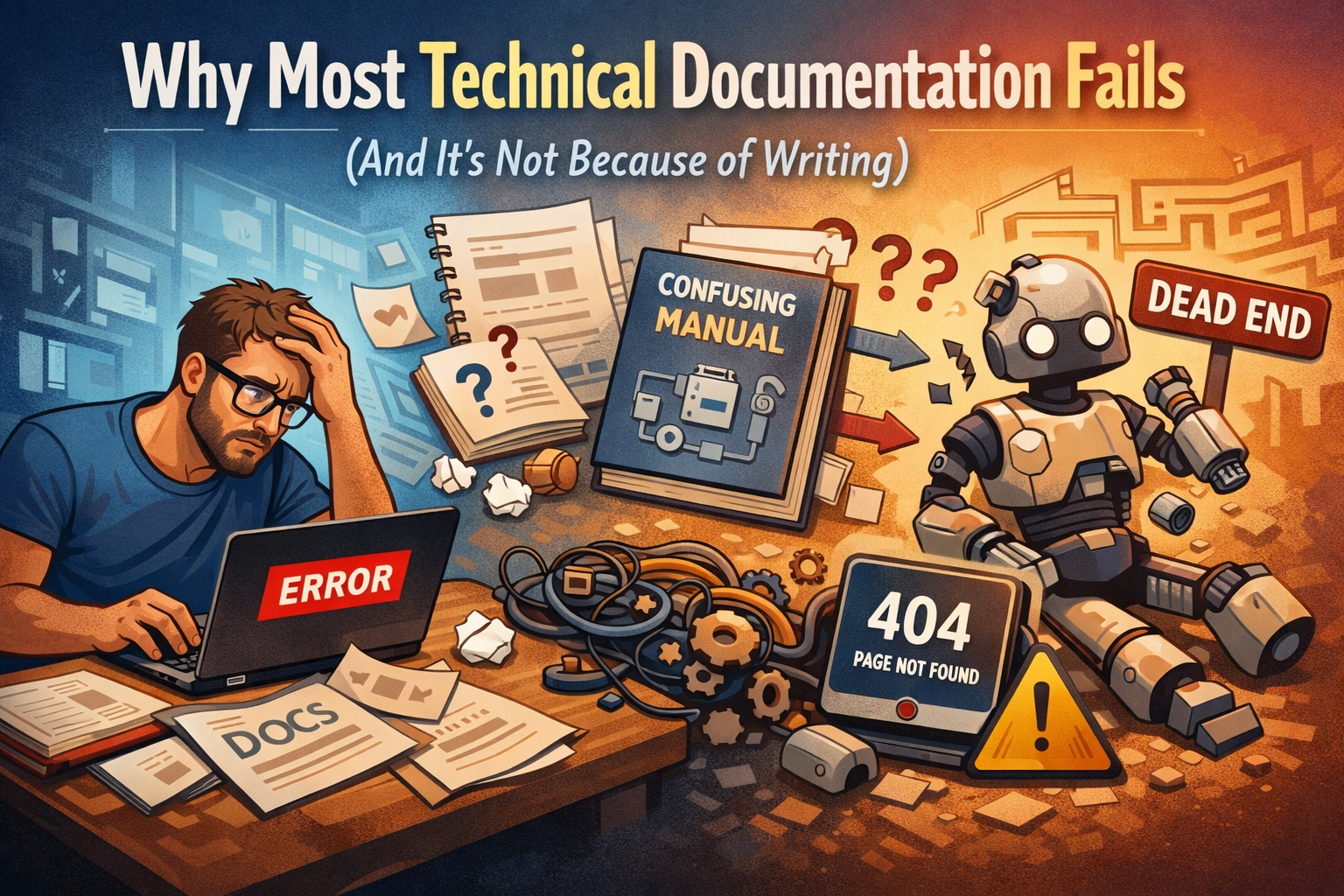
Why Most Technical Documentation Fails (And It’s Not Because of Writing)
When technical documentation fails, the default explanation is usually the same:
“The writing wasn’t good.”
That diagnosis is comforting—but often wrong.
In most cases, documentation doesn’t fail because sentences are poorly written or grammar is incorrect. It fails because the thinking behind the documentation was incomplete, rushed, or misaligned with how readers actually use information.
Writing quality matters, but it’s rarely the root cause.
The Real Problem: Documentation Is Treated as a Deliverable
In many teams, documentation is something that happens after decisions are made.
- The system is designed.
- The feature is shipped.
- The architecture is locked.
Only then does documentation enter the picture—often under time pressure, with limited context, and little influence over structure or intent.
At that point, documentation becomes a record of decisions, not an explanation of them.
This is the first and most common failure mode.
Good documentation is not a byproduct of development. It is part of the design process itself.
Completeness Is Mistaken for Usefulness
Another common assumption is that more documentation equals better documentation.
As a result, teams try to:
- Cover every edge case
- List every configuration option
- Include every internal detail
The outcome is documentation that is technically complete—but cognitively overwhelming.
Readers don’t approach documentation asking, “What exists?”
They approach it asking, “What do I need to understand right now?”
When everything is presented at the same level of importance, nothing feels clear.
Clarity comes from selection, not accumulation.
Missing Problem Statements
Many documents jump straight into solutions.
They explain:
- How a system works
- What components exist
- What steps to follow
But they never clearly answer:
- What problem this system is solving
- Why this approach was chosen
- What trade-offs were accepted
Without that context, readers are forced to infer intent—and inference is fragile.
When documentation lacks a clear problem statement, even well-written content feels confusing. The reader understands the how, but not the why.
That gap erodes trust.
Assumed Context Is the Silent Failure
Another subtle but damaging issue is assumed knowledge.
Documentation is often written by people deeply familiar with the system. As a result, it unconsciously assumes:
- Prior architectural understanding
- Shared vocabulary
- Historical decisions the reader was never part of
This leads to explanations that are technically accurate but practically inaccessible.
Good documentation does not assume context—it establishes it.
That doesn’t mean explaining everything.
It means explaining the right things, at the right level, for the intended reader.
Documentation Without Structure Is Just Information
Even strong content fails when it lacks structure.
Without clear progression, readers struggle to answer:
- Where should I start?
- What can I skip?
- How deep do I need to go?
Structure is not cosmetic.
It is how meaning is communicated.
Well-structured documentation guides the reader’s attention. Poorly structured documentation forces the reader to work harder than necessary—and most won’t.
Writing Is the Last Mile, Not the Foundation
By the time writing begins, many documentation failures are already locked in:
- Unclear intent
- Missing context
- Conflicting priorities
- No defined audience
At that stage, even excellent writing can only do so much.
This is why focusing solely on writing quality rarely fixes documentation problems.
Clarity is created earlier—through thinking, design, and intentional decisions about what matters.
What Actually Makes Documentation Work
Documentation succeeds when:
- The problem is clearly stated
- The reader is explicitly defined
- Context is established before detail
- Structure reflects how the information will be used
- Completeness is balanced with clarity
Writing then becomes a tool for refinement—not damage control.
A Shift in Perspective
If documentation is consistently failing, the question to ask is not:
“How can we write this better?”
But rather:
“What are we trying to help the reader understand?”
That shift—from writing as output to documentation as explanation—changes everything.
Closing Thought
Most documentation doesn’t fail because it’s poorly written.
It fails because clarity was never treated as a design requirement.
DraftRefine exists to challenge that pattern—to treat writing not as a final step, but as a way to think more clearly about systems, decisions, and intent.
If documentation feels hard to write, it’s often because the thinking isn’t finished yet.
And that’s where refinement begins.
 Why Technical Writers Should Own Their Platform